Probability Modeling Applications for Multi-Leg Bet Construction with Deposit Match Incentives in Football and Horse Racing Markets
Dana Schröder · Sep 15, 2026

Probability Modeling Applications for Multi-Leg Bet Construction with Deposit Match Incentives in Football and Horse Racing Markets
Probability modeling serves as a core tool for constructing multi-leg bets in football and horse racing, where bettors combine multiple outcomes into single wagers that carry higher potential returns alongside elevated risk levels. These models draw on historical performance data, current form indicators, and environmental variables to estimate the joint probability of several events occurring together, which directly informs stake allocation when deposit match incentives expand available bankrolls.
Core Techniques in Football Accumulator Construction
Football markets lend themselves to Poisson-based simulations because goal scoring follows a roughly independent distribution across matches, allowing researchers to generate expected goal totals for each team before calculating the probability of specific scorelines across multiple fixtures. When deposit match offers add equivalent funds to initial deposits, the effective stake per leg can increase without altering the underlying probability thresholds, which shifts the break-even point for accumulators that require four or more correct selections. Observers note that models incorporating both team strength metrics and recent injury data produce more stable joint probability estimates than those relying solely on league position, particularly in European domestic competitions where fixture congestion affects performance consistency.
Extensions to Horse Racing Multi-Leg Bets
Horse racing introduces additional variables such as track conditions, jockey changes, and barrier draws that require multinomial logit or machine learning classifiers to assign win probabilities across fields of eight to twenty runners. Multi-leg constructions in this sport often combine win or each-way selections from separate meetings, and probability outputs must account for the fact that only one horse per race can succeed. Deposit match incentives interact with these models by increasing the number of combinations a punter can fund, which in turn raises the aggregate probability mass covered by the bettor's portfolio while the per-race probabilities remain unchanged. Data compiled through September 2026 indicates that operators in Australian and North American markets have refined their each-way payout structures in response to updated modeling accuracy from academic studies on race outcomes.
Integrating Deposit Matches into Model Outputs
Deposit match incentives typically function as a percentage uplift on the initial deposit amount, creating a temporary expansion of betting capital that probability models can treat as an additional risk buffer. When constructing a five-leg football accumulator, for instance, a model might output a joint probability of 0.028 for the selected outcomes; the deposit match effectively lowers the required implied odds threshold because the same stake now represents a smaller fraction of total available funds. In horse racing contexts, where each-way bets split stake across win and place markets, the matched deposit allows separate modeling runs for place probabilities that often exceed 0.25 per runner, thereby diversifying the overall exposure across the multi-leg structure. Industry reports from the Victorian Responsible Gambling Foundation highlight how such incentives alter participation patterns without changing the mathematical expectation of the underlying events.
Practical Workflow for Combined Markets
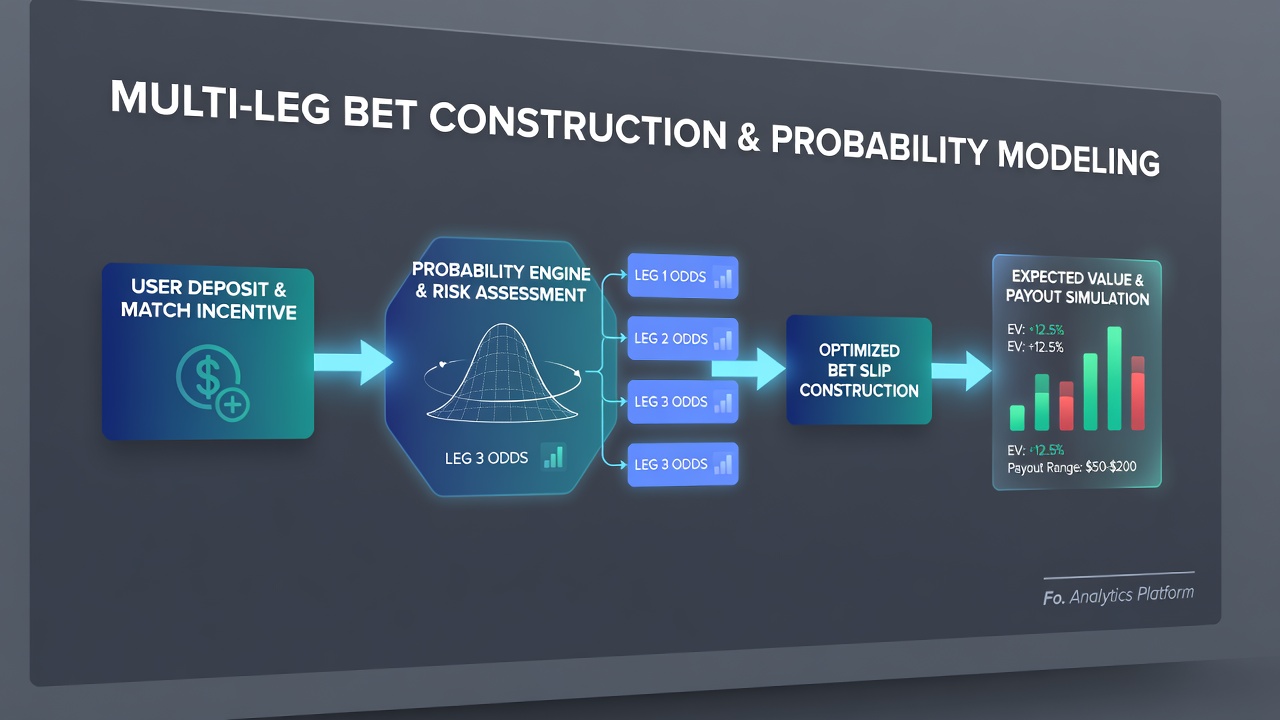
Bettors who apply these models typically begin by scraping or accessing public performance datasets, then run Monte Carlo iterations to simulate thousands of possible outcome combinations across selected legs. The resulting distribution of accumulator returns is compared against the boosted bankroll created by the deposit match, which determines whether the expected value remains positive after accounting for the bookmaker's margin on each leg. In practice, football models often emphasize over/under totals or Asian handicap lines because these reduce variance compared with match-result selections, while horse racing models prioritize races with clear form leaders where place probabilities cluster more predictably. And because deposit matches frequently carry wagering requirements expressed as multiples of the matched amount, probability thresholds must incorporate the full turnover needed to release any associated winnings before the model can declare a construction viable.
Regional Data Sources and Model Refinement
Updates to probability frameworks draw from regulatory disclosures across multiple jurisdictions, including the Victorian Responsible Gambling Foundation reports on betting volumes and the Gambling Research Exchange Ontario datasets that track accumulator popularity in Canadian markets. These sources supply anonymized outcome frequencies that allow recalibration of Poisson parameters for football and logit coefficients for thoroughbred racing at regular intervals, ensuring the models reflect shifts in scoring rates or field sizes that occur season to season. Observers note that September 2026 saw several operators release updated API endpoints containing granular leg-level data, which in turn improved the precision of joint probability calculations for multi-leg products that incorporate both sports.
Conclusion
Probability modeling applied to multi-leg bet construction supplies a systematic method for quantifying the combined likelihood of outcomes in football and horse racing while deposit match incentives modify the capital constraints under which those models operate. The integration of simulation outputs with expanded bankrolls produces stake-sizing rules that remain grounded in empirical distributions rather than intuition, and ongoing data releases from regulatory bodies continue to support incremental improvements in model calibration across both markets.